
Yes or No Wheel vs Random Number Generator: Which Tool Should You Use?
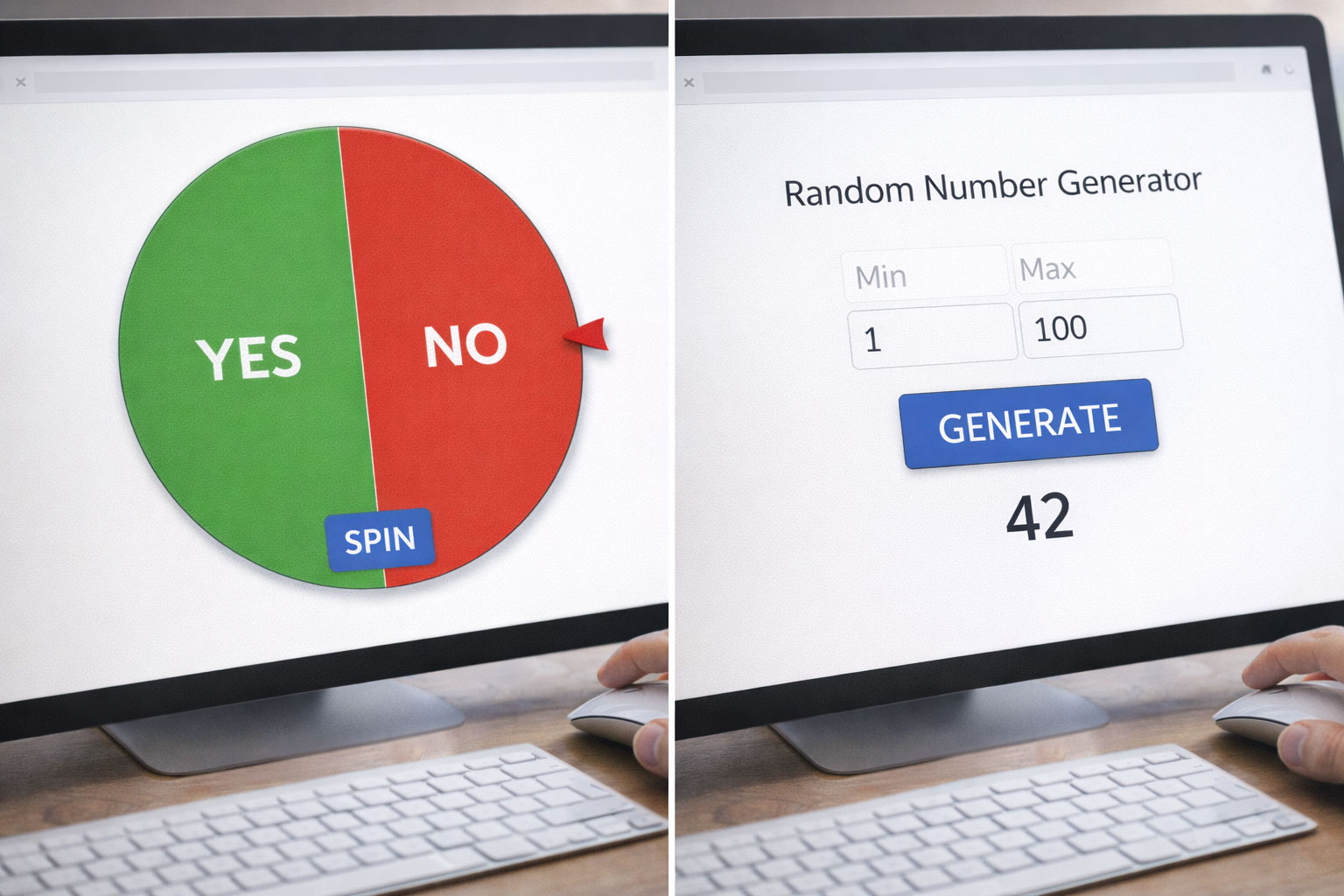
Compare the Yes or No Wheel and random number generators to see which tool works best for quick decisions, games, and fair choices.
Let’s start with something we all experience more often than we admit. You’re stuck between two options. Yes or no. Do it or don’t do it. Pick option A or option B. It should be simple… and yet you hesitate 😅. This exact mental pause is where decision tools come into play, and two of the most common ones people reach for are the Yes or No Wheel and the Random Number Generator (RNG).
On the surface, they seem to do the same thing. Both introduce randomness. Both remove responsibility from the chooser. Both promise fairness. But in practice, they serve very different psychological and practical purposes, and choosing the wrong one can make a decision feel awkward, unsatisfying, or even unfair.
In this in-depth guide, we’ll break down what each tool really is, why people trust them, how they work, when each one shines, and which one you should use depending on context. We’ll blend definitions, real-world examples, metaphors, a simple conceptual diagram, emotional insights, and practical scenarios, all in a friendly, human tone that reflects how people actually use these tools in daily life 😊.
What Is a Yes or No Wheel? 🎡
A Yes or No Wheel is a visual decision tool that presents two outcomes, “Yes” and “No,” as segments on a spinning wheel. When you spin the wheel, it rotates with animation and lands on one of the two outcomes.
Technically, it’s a binary random selector. Psychologically, it’s much more than that.
The wheel introduces movement, anticipation, and ritual. Watching the wheel spin creates a small emotional journey. There’s suspense. There’s a pause. There’s a moment where you already feel which answer you’re hoping for before the wheel even stops 😄.
This is important, because the Yes or No Wheel doesn’t just give you an answer. It often reveals how you feel about the answer.
What Is a Random Number Generator? 🔢
A Random Number Generator is a tool that produces a number within a defined range, such as 1–2, 1–10, or 1–100. When used for yes/no decisions, it typically maps:
1 = Yes
2 = No
RNGs are mathematically precise, fast, and neutral. They are widely used in computing, simulations, statistics, and games because they provide pure randomness without ceremony.
Where the wheel invites emotion, the RNG strips emotion away. It gives you an answer instantly, without drama, without buildup, and without visual storytelling.
That efficiency is either a strength or a weakness, depending on what you’re trying to achieve.
Why This Comparison Actually Matters ⚖️
At first glance, you might think: random is random, so who cares how it’s delivered? But humans don’t interact with randomness like machines do.
We care about:
how fair something feels
whether others trust the process
whether the decision feels satisfying
whether the moment creates engagement or resistance
This is why choosing between a Yes or No Wheel and a Random Number Generator isn’t about math. It’s about context, psychology, and social dynamics.
How Each Tool Works (Conceptual View) 🧠
Let’s simplify the mechanics.
Yes or No Wheel flow:
Options defined → Visual wheel created → Spin animation → Random selection → Emotional response
Random Number Generator flow:
Range defined → Number generated → Value mapped → Decision output
Here’s a simple mental diagram you can imagine:
Decision input
⬇️
Random logic
⬇️
Wheel = experience 🎡
RNG = result 🔢
Both arrive at randomness. Only one creates a shared moment.
When the Yes or No Wheel Is the Better Choice 🎡✨
The Yes or No Wheel shines when people are involved emotionally or socially.
It’s ideal when:
you’re deciding in a group
fairness must be visible
engagement matters
the decision is light to medium stakes
you want the process to feel fun
For example, in a classroom, asking “Should we do a quiz today?” and spinning a Yes or No Wheel turns a potentially tense moment into excitement. Students lean in. They laugh. They accept the result because they saw it happen.
In content creation or live streams, spinning a wheel feels like a show. Viewers don’t just get an answer, they get entertainment 🎥.
Even for personal decisions, the wheel often reveals your inner preference. If the wheel lands on “No” and you feel disappointed, that’s valuable insight. The wheel didn’t just decide. It held up a mirror.
When a Random Number Generator Is the Better Choice 🔢🧘
The RNG excels when speed, neutrality, and efficiency are the priority.
It’s ideal when:
the decision is purely technical
no one else needs to see the process
emotional engagement is irrelevant
you want the fastest possible answer
the outcome must feel detached
For example, in software testing, simulations, or quick internal decisions, an RNG is perfect. No animation. No waiting. Just a result.
Even personally, some people prefer RNGs when they don’t want to think. If you’re tired and just want an answer without emotional buildup, the instant nature of an RNG can feel relieving 😌.
A Metaphor That Makes the Difference Clear 🎭
Think of the Yes or No Wheel as a stage performance. There’s a buildup, a spin, a reveal, and applause or groans at the end.
Think of the Random Number Generator as a calculator. You press a button and get an answer.
Both are correct. Only one fits the mood.
Emotional and Psychological Impact ❤️
This is where the wheel often wins.
Humans give more legitimacy to decisions when they feel witnessed. The wheel creates that sense of ceremony. It externalizes responsibility. “I didn’t choose this. The wheel did.”
RNGs, while fair, often feel invisible. If someone doesn’t trust the person pressing the button, they may not trust the outcome, even if it’s mathematically sound.
In group settings especially, perceived fairness beats actual fairness every time.
Real-Life Examples 🌍
A teacher choosing whether to give homework uses a Yes or No Wheel and turns groans into laughter.
A developer deciding which test case to run next uses an RNG and moves on instantly.
A family deciding “movie night or game night?” spins a wheel and accepts the outcome together 🎬🎲.
A solo thinker deciding between two ideas uses an RNG and avoids overthinking.
Same logic. Different human needs.
Frequently Asked Questions (FAQ) ❓
1. Are Yes or No Wheels truly random?
Yes, they rely on randomization logic just like RNGs.
2. Is an RNG more accurate?
Mathematically, they’re equivalent for binary choices.
3. Why does the wheel feel fairer?
Because the process is visible and shared.
4. Which is better for group decisions?
Almost always the Yes or No Wheel.
5. Which is better for private decisions?
Either, depending on whether you want emotion or speed.
6. Can wheels be manipulated?
Only if set up dishonestly. Transparency prevents this.
7. Does animation affect the outcome?
No. It only affects perception.
8. Are RNGs boring?
Not boring, just functional.
9. Can wheels reduce arguments?
Yes, significantly.
10. Should I always use one tool?
No. Match the tool to the moment.
People Also Asked 🤔
Is a Yes or No Wheel just a coin flip?
Conceptually yes, emotionally no.
Why do people trust spinning wheels?
Because randomness feels more honest when you can see it.
Is an RNG better for serious decisions?
Serious decisions should use judgment first, tools second.
Final Verdict: It’s About Humans, Not Math 🎯
The Yes or No Wheel and the Random Number Generator do the same thing on paper, but they do very different things in the real world.
If you want engagement, trust, and shared acceptance, use the wheel 🎡.
If you want speed, neutrality, and zero ceremony, use the RNG 🔢.
The best decision tool isn’t the most precise one. It’s the one that fits the people, the moment, and the emotion behind the choice.
Sometimes you need an answer.
Sometimes you need an experience.
Choose accordingly 😊